
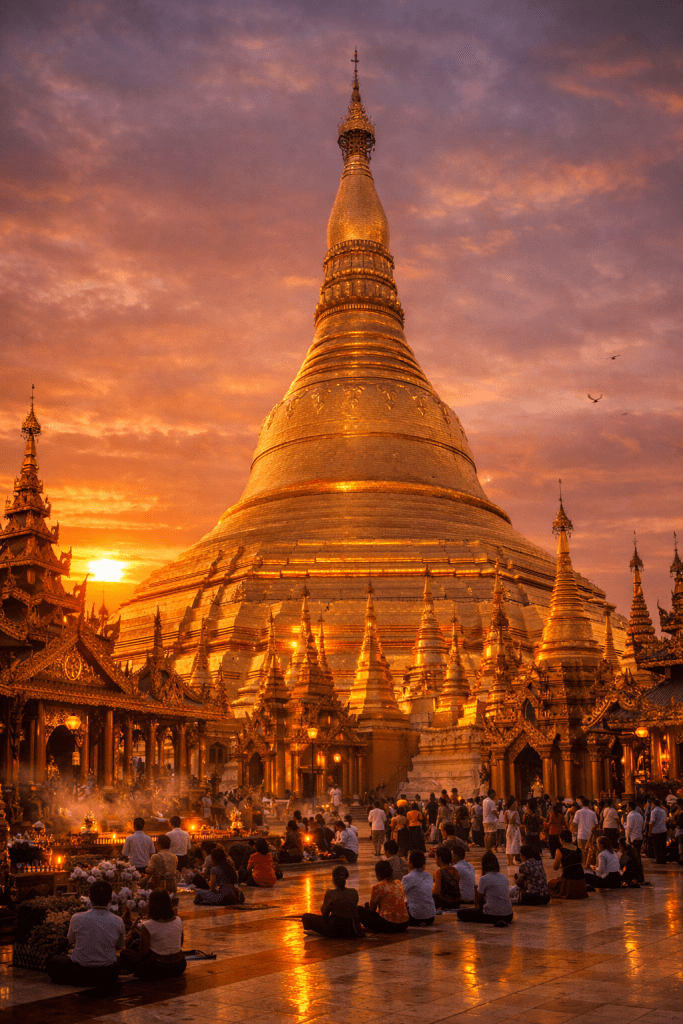
Across the plains of Myanmar, thousands of golden stupas rise toward the sky, catching the light of dawn and dusk in radiant brilliance. These sacred monuments are more than architectural wonders — they are enduring symbols of a civilization shaped by the teachings of the Buddha.
Myanmar (formerly Burma) has long been regarded as one of the most important strongholds of Theravāda Buddhism, preserving both the textual tradition of the Pāli Canon and the living practice of meditation for centuries.
Shwedagon Pagoda: A Living Beacon of Faith
In Yangon stands the Shwedagon Pagoda, the most revered Buddhist site in Myanmar and one of Southeast Asia’s most sacred monuments.
According to Buddhist tradition, the stupa enshrines relics of four Buddhas, including strands of hair from Gautama Buddha. While historians debate its earliest construction date, the site has been venerated for well over a millennium and remains an active center of devotion, meditation, and pilgrimage.
Covered in gold plates and crowned with a jewel-studded umbrella finial (hti), the Shwedagon does not merely reflect sunlight — at sunset, it seems to radiate it. Yet its true brilliance lies not in gold, but in the faith and continuity it represents.
Bagan: A Landscape of Devotion
Further north lies Bagan, one of the world’s great archaeological and spiritual landscapes. Between the 9th and 13th centuries, more than 2,000 temples and stupas were constructed across the plain during the Pagan Kingdom.
These monuments were built not as displays of imperial power alone, but as acts of merit — expressions of a society deeply rooted in Buddhist values. Kings, monks, and lay practitioners alike contributed to a culture in which spiritual aspiration shaped architecture, art, and daily life.
Today, at sunrise, the silhouettes of temples emerging from mist evoke a vision of a civilization organized around the pursuit of wisdom and liberation.
The Fifth Buddhist Council: Preserving the Canon in Stone
In 1871, King Mindon convened the Fifth Buddhist Council in Mandalay. In an extraordinary preservation effort, the entire Pāli Canon (Tipiṭaka) was inscribed onto 729 marble slabs.
Each slab was placed within its own small white shrine at Kuthodaw Pagoda — often referred to as “the world’s largest book.” This monumental undertaking ensured that the Buddha’s teachings would be safeguarded not only through oral transmission, but also in enduring physical form.
The Sixth Council and the Modern Revival of Practice
From 1954 to 1956, Myanmar hosted the Sixth Buddhist Council in Yangon. Thousands of learned monks recited, examined, and reaffirmed the Pāli Canon to maintain textual integrity in the modern era.
During the 20th century, Myanmar also became central to the preservation and global transmission of Vipassanā (insight meditation). Teachers such as Sayagyi U Ba Khin played a key role in passing the practice to students who later introduced it to the wider world.
Through these efforts, Myanmar helped ensure that meditation remained not only a historical doctrine, but a living discipline.
Gold as an Offering, Not an Ornament
Myanmar’s golden stupas are often described in terms of splendor, yet their significance runs deeper. The gold adorning these structures is traditionally offered as an act of devotion — a symbol of gratitude toward the Dhamma rather than a display of wealth.
For centuries, despite political changes and social challenges, the spiritual heart of the country has continued to beat in monasteries, meditation halls, and sacred sites.
The enduring message of Myanmar’s sacred landscape is clear:
When preserved with sincerity and practice, the Dhamma can endure across generations.
 Dhamma Servants
Leave a comment